
Hallacas (Venezuelan Tamales)
- Yield
- Makes about 50-70 hallacas
- Difficulty
- hard
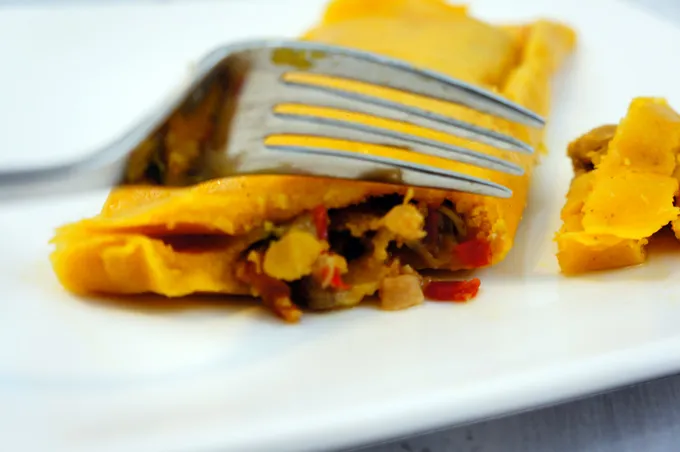
This week’s recipe really had all of us going bananas! It would not be Christmas without this traditional holiday meal, particularly in our Venezuelan household. For two days, our extended family joins us in the kitchen and turns our house upside down while preparing the hallacas.
From multiple sources and storytelling, we discovered the origin of hallacas, or at least the popular myth attached to it. According to our grandmother, parents, uncles, and aunts, the recipe all began during colonial times, when the wealthy class in Venezuela would have extravagant feasts. Every kind of food was prepared for the meal, and the leftovers were given to the slaves, who worked the plantain and corn plantations. They would grind the corn over and over again into a fine dough, mix in the leftovers, and fold it into a small package using plantain leaves. It is fitting, then, that the word hallaca comes from the Guaraní word “ayua” or “ayuaca,” meaning “mix” or “stir.”
It takes approximately two days, a lot of extra hands, and patience. For this reason, we warn anyone attempting to make our recipe this week that it is only suitable for “crazy, experienced Venezuelan people.” Good luck!
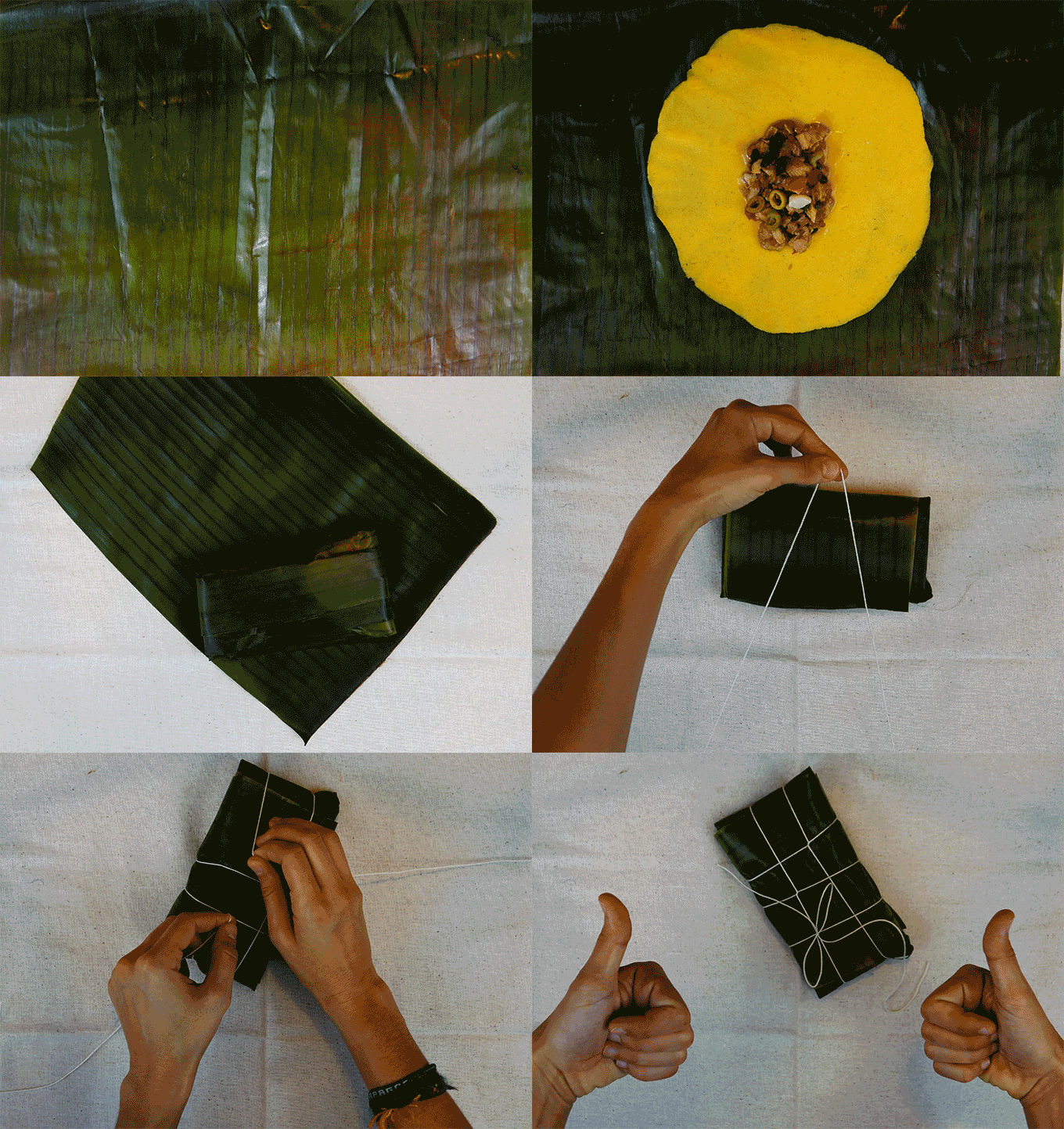
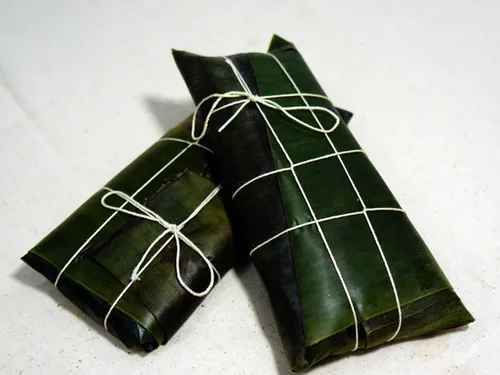
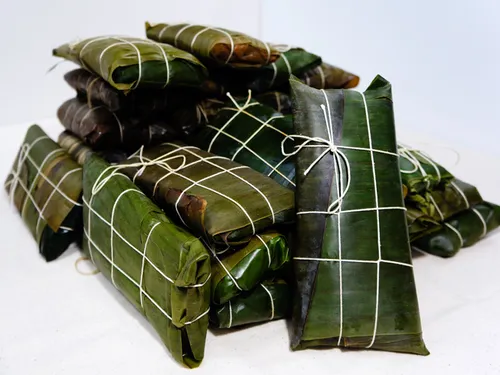
Here’s how the final fold comes together:
Ingredients
Filling
- 6.5 lbs pork chops (3 kg)
- 2 medium hens (4.5 lbs / 2 kg each)
- 5 limes
- 1 cup vegetable oil
- 7 onions
- 2 large leeks (white part only)
- 5 bunches of green onions
- 1 bulb of garlic
- 1/2 cup capers
- 6 red bell peppers
- 7 large tomatoes
- 1 tbsp hot pepper
- 0.6 lbs Italian mix giardiniera, assorted mixed pickled vegetables (270 g)
- 2 tbsp yellow mustard
- 2 cups Marsala wine
- 1 cup red wine vinegar
- 2/3 cup Worcestershire sauce
- 0.5 lbs papelón, raw hardened sugar cane juice (250 g)
- 1 tbsp black pepper
- 5 tbsp salt
- 2 1/2 cups hen broth (prepared while cooking the hen)
- 4 small sweet peppers
Dough
- 9 lbs precooked white corn flour, maíz meal (4 kg)
- 10 tbsp annatto (achiote/onotto) seeds
- 8 cups hen broth
- 3 salted pork (1 1/2 kg)
- 5 tbsp salt
- 1 1/2 cup water
Assembly ingredients & tools
- 17.5 lbs frozen plantain leaves, Goya brand (8 kg)
- 5 one-gallon plastic ziplock bags
- 400 yds cotton twine
- Small rag
- 2 cups sliced, pitted manzanilla olives
- 2 cups raisins
- 1 cup capers
- 2 cups Italian mix giardiniera, mixed pickled vegetables
- 1 cup sliced almonds
- Day 2's salted pork bits (see Day 2 instructions)
- Day 2's colored rendered fat leftovers (see Day 2 instructions)
Instructions
Day 1
- In a large pot, add the pork chops, cover with water, and cook for about 20 minutes or until pink (not fully cooked). Chop into 1/2-inch squares and set aside.
- Clean the hens, taking off any excess fat. Rub with lime and rinse well. Place both hens in a large pot with half an onion and the green part of the leeks. Boil for approximately 35 minutes. Remove the hens from the pot and let stand until cooled to room temperature. Chop the hen meat into small (~1/2-inch) cubes and set aside. Store all of the hen broth in the fridge for later use in preparing the dough.
- Chop the salted pork into 1/8-inch cubes and add to a medium-sized pot along with 1 cup of water. Cook on high heat for about 30-40 minutes, stirring continuously with a wooden spoon to avoid burning, until no more fat is released from the salted pork and it becomes golden in color. Separate the rendered fat from the salted pork using a strainer, leaving the rendered fat in the pot. Store the salted pork bits in the fridge for use on Day 2. Add the annatto to the rendered fat and bring to a boil until the mixture turns a dark red color -- be careful not to burn the annatto seeds. Remove from the heat and strain to remove the seeds. Set aside the colored rendered fat for use on Day 2.
- Add 1/2 cup of vegetable oil to a very large cast aluminum pot ("caldero" -- cauldron in English).
- Chop the leeks, green onions, and rest of the onions into small squares and add to the pot. Grind the garlic and capers in 1/2 cup of hen broth (made earlier) and add to the pot. Sauté the vegetable mix on medium-high for about 20 minutes.
- Chop and add the bell peppers, tomatoes, sweet peppers, and pickled vegetables. Add the wine, vinegar, Worcestershire sauce, papelón (grated), black pepper, salt, 2 cups of hen broth, and mustard. Bring to a boil and cook for 10 minutes.
- Add the pork cooked in step 1, bring to a boil, and cook for 40 minutes. Add the chopped hen meat, bring to a boil, and cook for another 30-40 minutes. Make sure the filling is not watery -- this will be important later in the preparation of the hallacas. If watery, cook a little longer.
Day 2
- In a disposable aluminum turkey tray, add the white corn flour. Add the rest of the salt to the hen broth made on Day 1. While kneading, slowly add the 8 cups of hen broth and 2 cups of colored rendered fat. Knead until the dough does not stick to the tray. Cover the dough with a wet cloth.
- Defrost the plantain leaves. Clean each leaf with a damp rag, always moving the cloth parallel to the veins. Cut the leaves into three distinct groups to be used for wrapping later -- the base leaf should be approximately 15in x 15in with minimal holes, the medium leaf approximately 12in x 12in, and the smallest leaf approximately 12in x 6in. Plan for approximately 70 of each.
Final preparation and assembly
- Place the large base leaf on a clean table. Warm up the colored rendered fat prepared earlier so it liquefies. Dip a small rag into the fat and spread a thin layer onto the base of the large leaf, moving the cloth along the veins, not across them.
- Make a small billiard-ball-sized ball of dough and place it in the middle of the large base leaf. Cut the ziplock bags in half along the seam and place on top of the ball of dough. Flatten the dough evenly until you reach a thickness of about 1/16 inch. Place approximately 4 tbsp of filling in a rectangular shape in the center of the dough, aligning the long edge of the rectangle parallel to the veins of the plantain leaf. Add three to four olives, capers, raisins, almonds, and pickles to the top of the filling.
- Fold and wrap into the final hallaca -- see the assembly animation below.
- Boil the hallacas in a pot of water for one hour. Remove from the pot, let cool, and drain in the sink for about 10 minutes. Be careful removing them, as the twine can tend to unravel.
Notes
- Hallacas may be kept in the freezer after initial boiling. To reheat, boil for ten minutes.